
BMW i7 Launch, Waterman House, Belfast
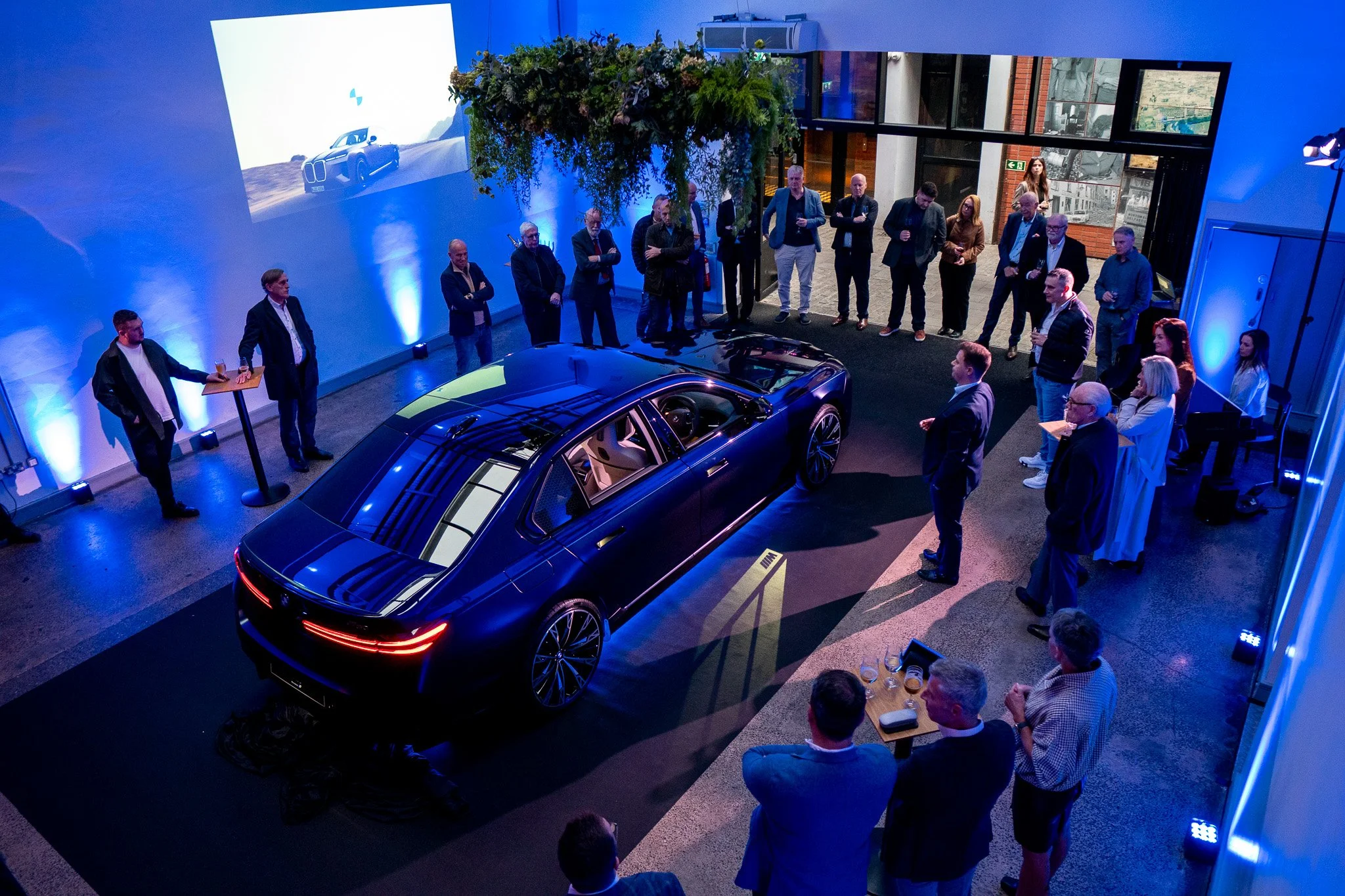
A car launch inside a Grade B listed building is a lighting problem before it is anything else.
Waterman House on Hill Street has been standing since the 1800s, first as a wine and spirits trader and later as Bushmills' bonded warehouse in Belfast. It is now one of the Cathedral Quarter's best event spaces, high-ceilinged and deliberately pared back, with six distinct rooms across three buildings. What it does not have, because listed warehouses never do, is a production lighting rig, a lighting bar or anywhere to hang one.
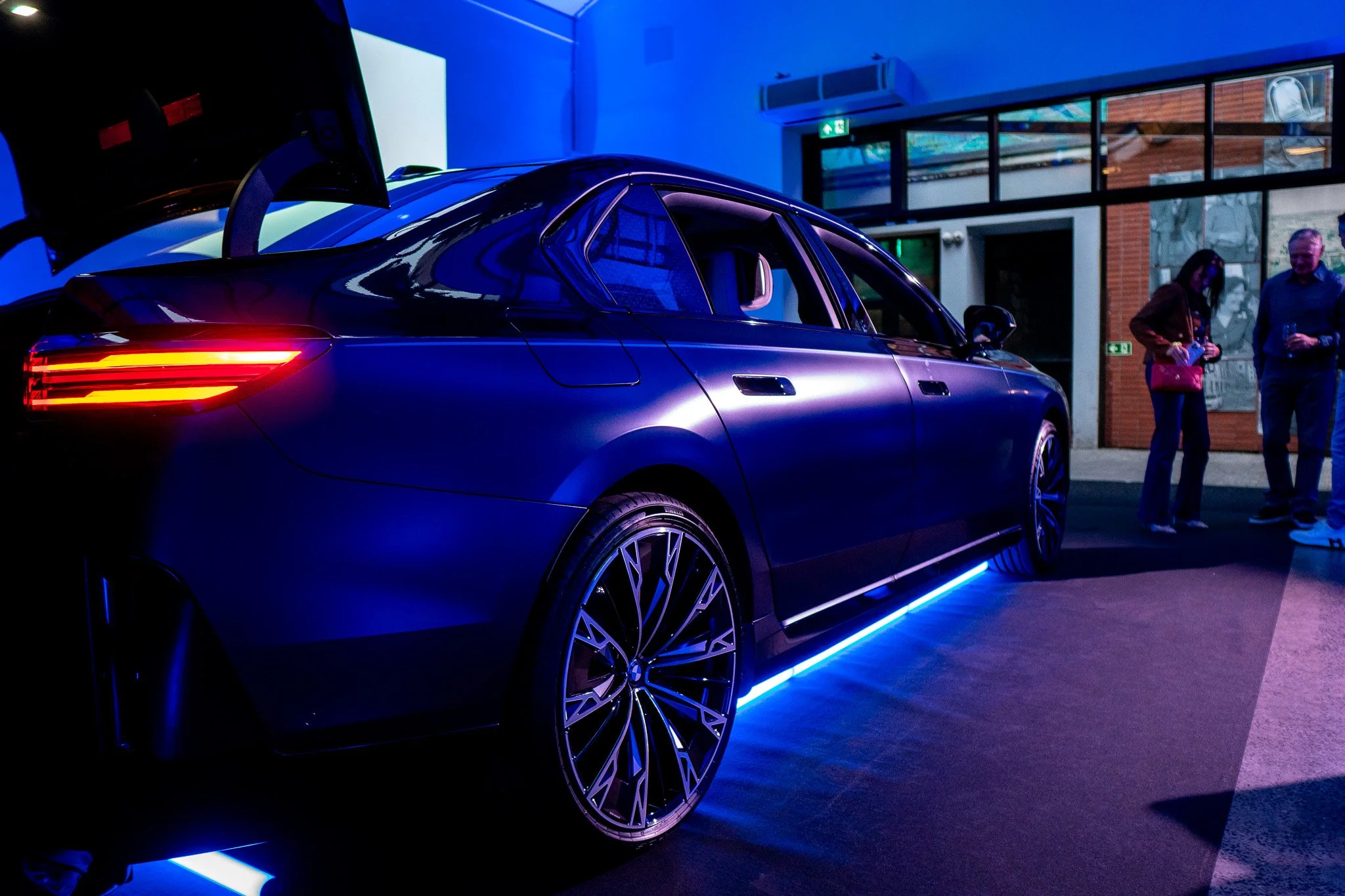
AXL was appointed to design, supply and operate the lighting for the Belfast launch of the BMW i7, the all-electric flagship of BMW's 7 Series range. Sixteen battery-powered uplighters, eight wireless LED tube lights and a pair of LED Fresnels turned a working restaurant into a brand space for the evening, with a cued reveal on the covered car at the centre of it.
Total power draw across every fixture in the building was 318W at 1.4A, which is less than a domestic kettle, and no power cable crossed a single guest route.
Planning a product launch, brand activation or press event in Belfast? AXL designs and operates lighting for venues that were never built to be production spaces.Get in touch with Team AXL.
The Brief
A manufacturer launch has a narrower brief than a conference, and a harder one. There is no stage, no lectern and no slide deck. There is a car, an audience walking around it, and a brand standard that governs exactly how the product is allowed to look.
The brief came down to four things:
Light a large, highly reflective piece of bodywork so it reads as designed, without the hot spots and hard shadows that conventional fixtures produce on a painted panel
Take a listed restaurant interior to BMW's brand blue, without touching, covering or fixing anything to the building
Work inside a live hospitality venue with nothing crossing guest or service routes
Deliver a cued lighting moment as the cover came off the car, timed to the client's running order rather than improvised
Our Solution
A wireless rig, because a listed building will not take a cabled one
Every fixture that shaped the room ran on internal battery. Sixteen LED uplighters and eight wireless LED tube lights went exactly where the design wanted them, including wall positions and corners that a cabled rig could not have reached without running power across a floor that was still in service.
That matters more in a building like Waterman House than almost anywhere else. A Grade B listed structure is not somewhere you drill, clamp or fix. There is no rigging position, the power is domestic ring main already loaded by a working kitchen, and the get-in is through the front door onto a cobbled street rather than a loading bay. Battery stock is what makes a room like that lightable at all.
The only mains-fed fixtures were the two Fresnels lighting the car, run from fixed positions.
This is a capability rather than a product. It depends on owning enough battery stock to light a full room from it, and on that stock being charged, tested and logged before it leaves the warehouse. It is why we can work in restaurants, showrooms, historic interiors and marquees, and it is the first question worth asking any AV supplier quoting on a venue like this one.
BMW blue, matched rather than approximated
Sixteen battery uplighters washed the room in BMW's brand blue, placed around the perimeter to lift the space without fighting the venue's own lighting. RGBW fixtures let us match a specified brand colour properly rather than get close to it with a gel, which on a manufacturer launch is the difference between on-brand and nearly.
Eight wireless LED tube lights added vertical structure through the room. Tubes do something uplighters cannot: they give the eye a repeated vertical line at height, which reads as designed rather than decorated, and they sit well in the background of every photograph taken on the night.
Front light on the car
Reflective bodywork is unforgiving. A hard-edged fixture gives you a bright stripe down the panel and a black shadow beside it, which is exactly what a brand team does not want on a launch car.
Two 160W RGBW LED Fresnels with zoom were placed at the front corners of the vehicle instead. A Fresnel gives a soft-edged, adjustable beam that can be widened to cover the length of the car and feathered at the edges, so the light falls away gradually rather than cutting. Two fixtures, cross-lighting from opposite corners, fill the panel without either one of them producing a hot spot.
The reveal
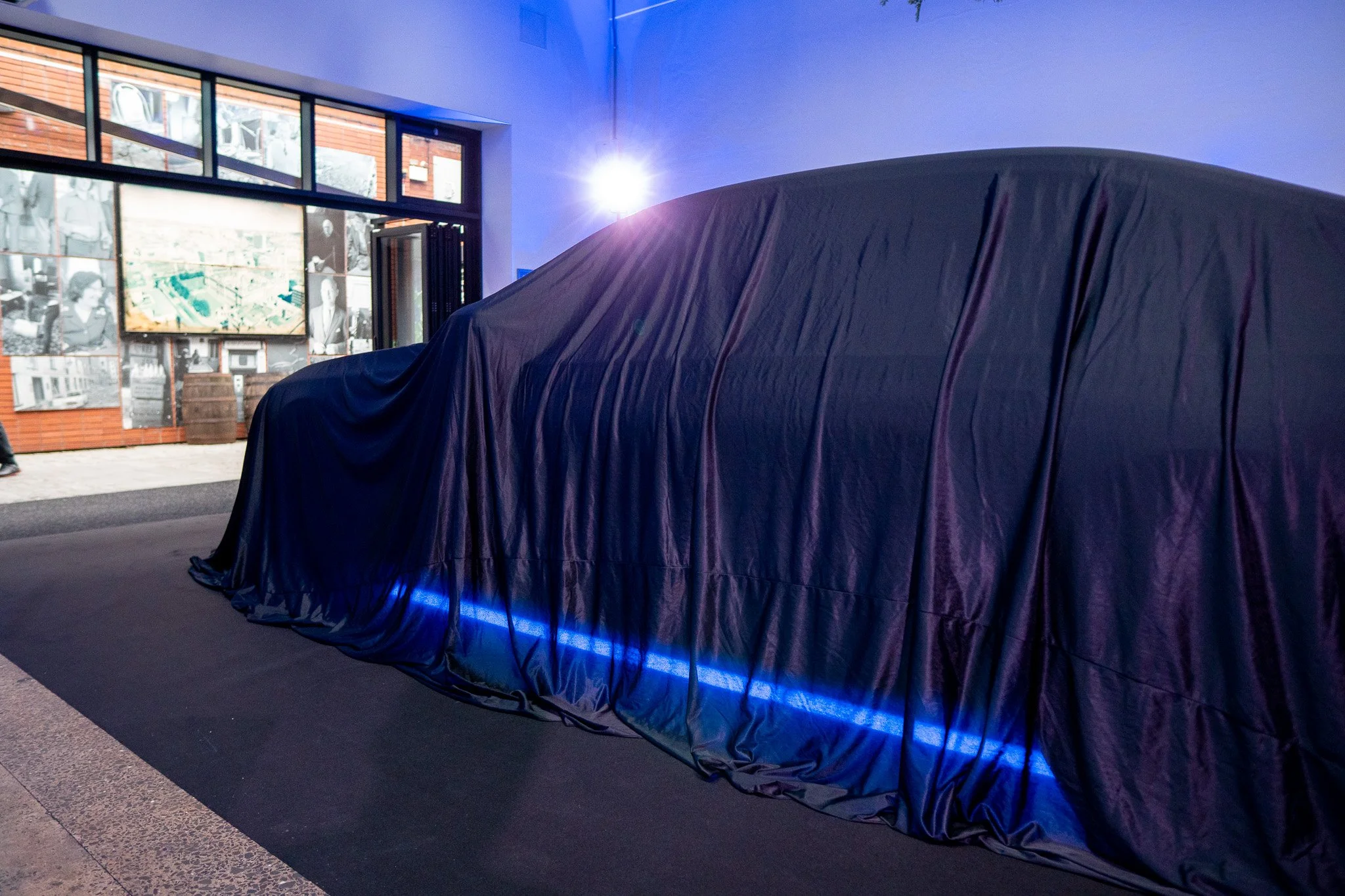
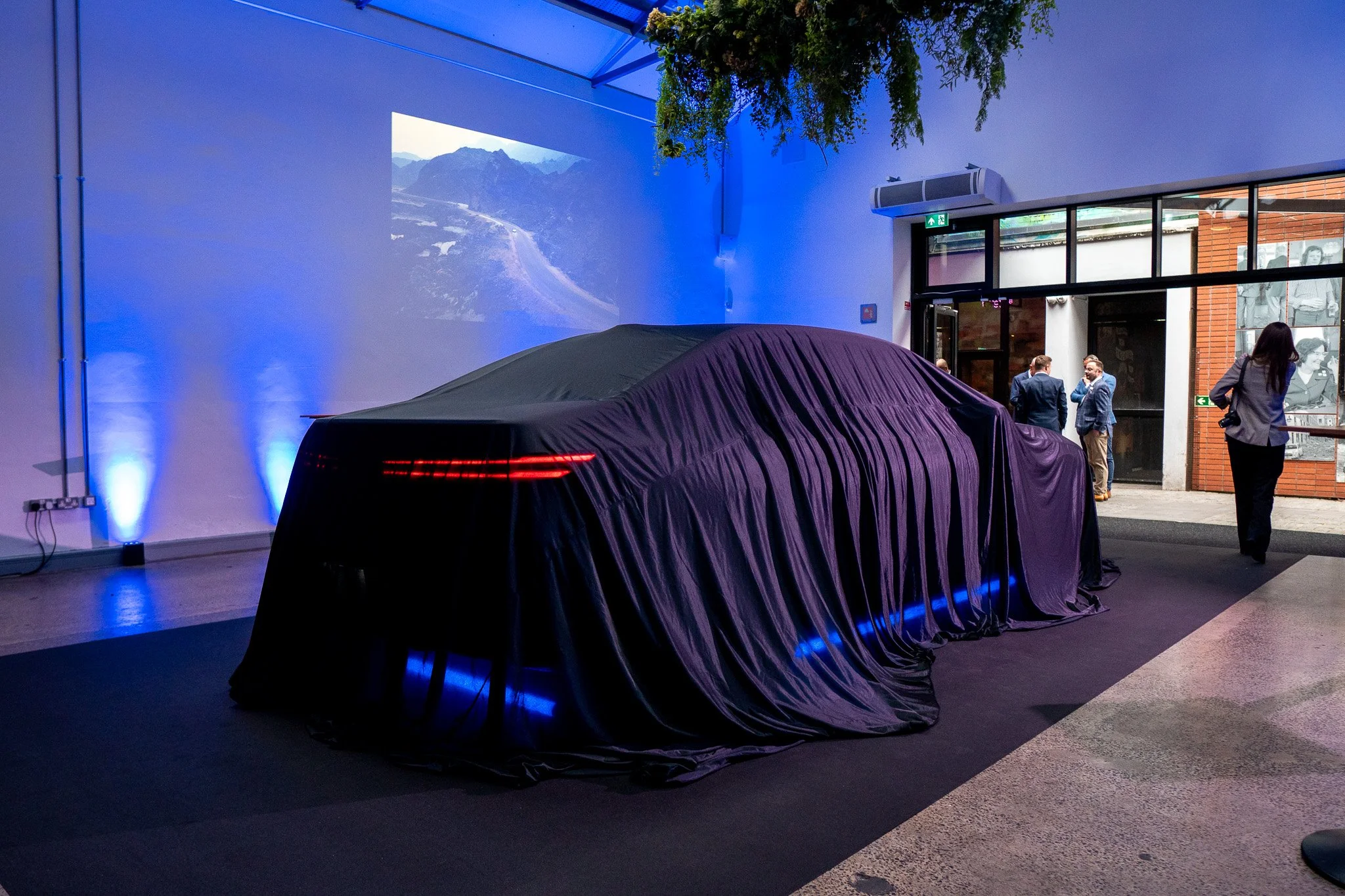
The car sat under cover at the centre of the room, with the front light already set, focused and waiting behind a dark cue.
The rig was programmed and operated live on an Avolites T3 console, with states built for arrival, the reveal and the reception that followed. When the cover came off, the change was executed on a cue: the room wash dropped back, the Fresnels came up on the bodywork, and the car became the brightest thing in a building with no lighting of its own.
That is the difference between hiring fixtures and hiring an operator. A reveal cannot be done by someone walking over to a dimmer. It has to be programmed in advance, set against the client's running order, and taken on a call.
Delivery and technical support
The whole rig was delivered, built, focused, operated and struck by a single AXL technician, from an afternoon get-in through the reveal and reception to a de-rig the same night.
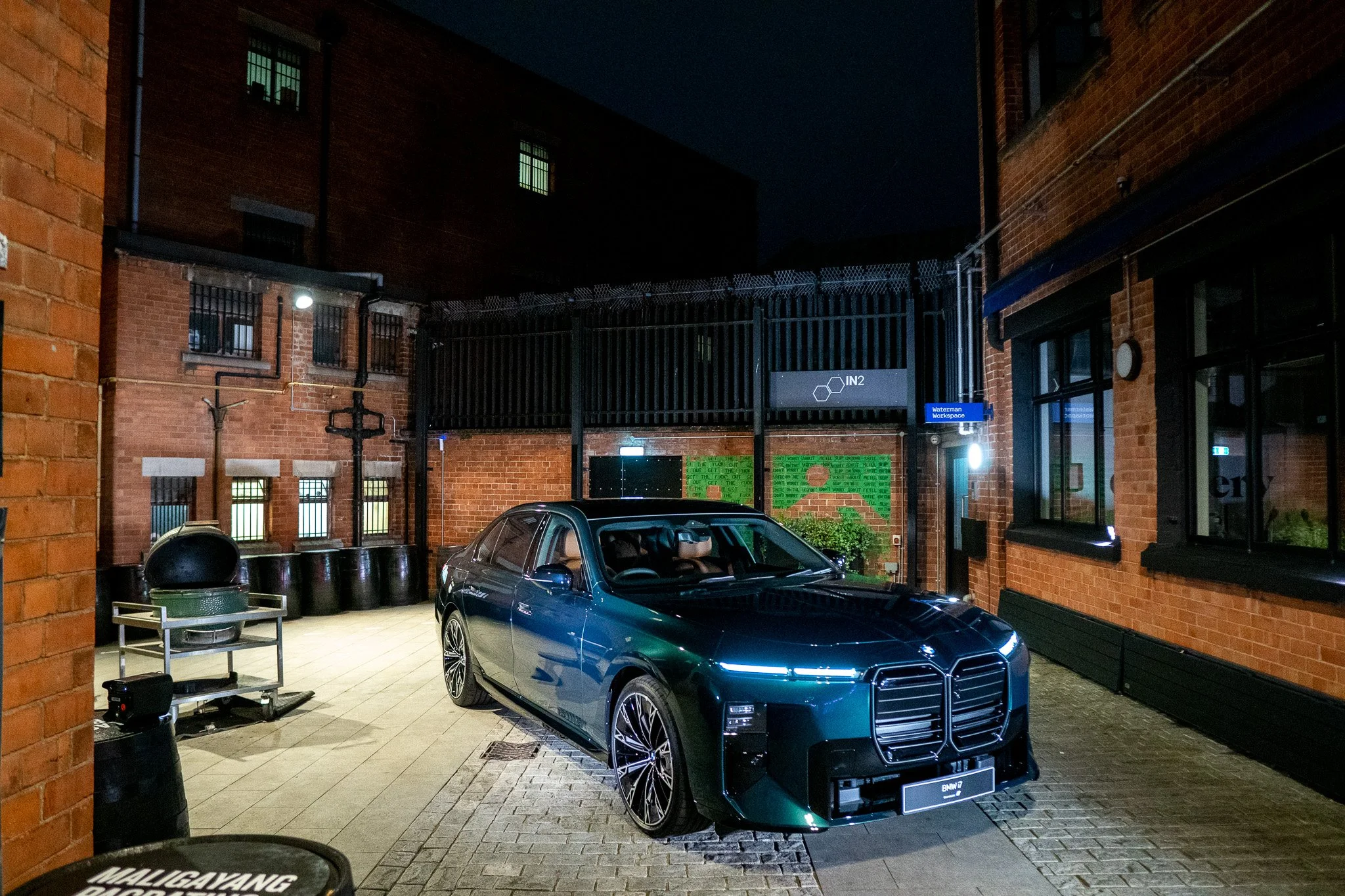
A second car sat outside on Hill Street across the evening.
The Result
The room read as BMW blue from the moment guests walked in, in a building that gave us nothing to work with beyond floor space and a power socket we chose not to use. The reveal landed on its cue, the bodywork lit cleanly without a hot spot on it, and the guest photographs from the night show a brand space rather than a restaurant with some lights in it.
None of that required the venue to be altered, and none of it required a cable across a floor that was in service until an hour before doors.
Waterman House is a genuinely good room, and a good example of the kind of venue we get asked to work in most often: characterful, listed, popular with brands, and not built for production. Rooms like that are the reason we hold the battery stock we do.
Planning a product launch, brand activation or press event in Belfast? AXL designs and operates lighting for venues that were never built to be production spaces.Get in touch with Team AXL
FAQ block
Can you light an event without running power cables across the floor? Yes. We hold enough battery-powered LED stock to light a full room without a mains run, which means fixtures go where the design wants them rather than where the sockets are. It is how we work in restaurants, showrooms, historic interiors and any room still in use while we build.
Can you work in a listed building? Regularly, and it is one of the main reasons clients call us. A listed building usually means no fixings, no rigging positions, no drilling and a get-in through the front door. Battery fixtures and freestanding positions let us light the room without touching the fabric of it. We survey first so the plan is agreed with the venue before anyone arrives with flightcases.
How much power does a full room of event lighting need? Less than most people expect. The complete rig for this launch drew 318W in total, under 1.5A. Where fixtures do need mains, a typical corporate lighting rig runs comfortably on standard 13A supplies. You only start needing three-phase once LED walls or large moving-light rigs enter the design.